

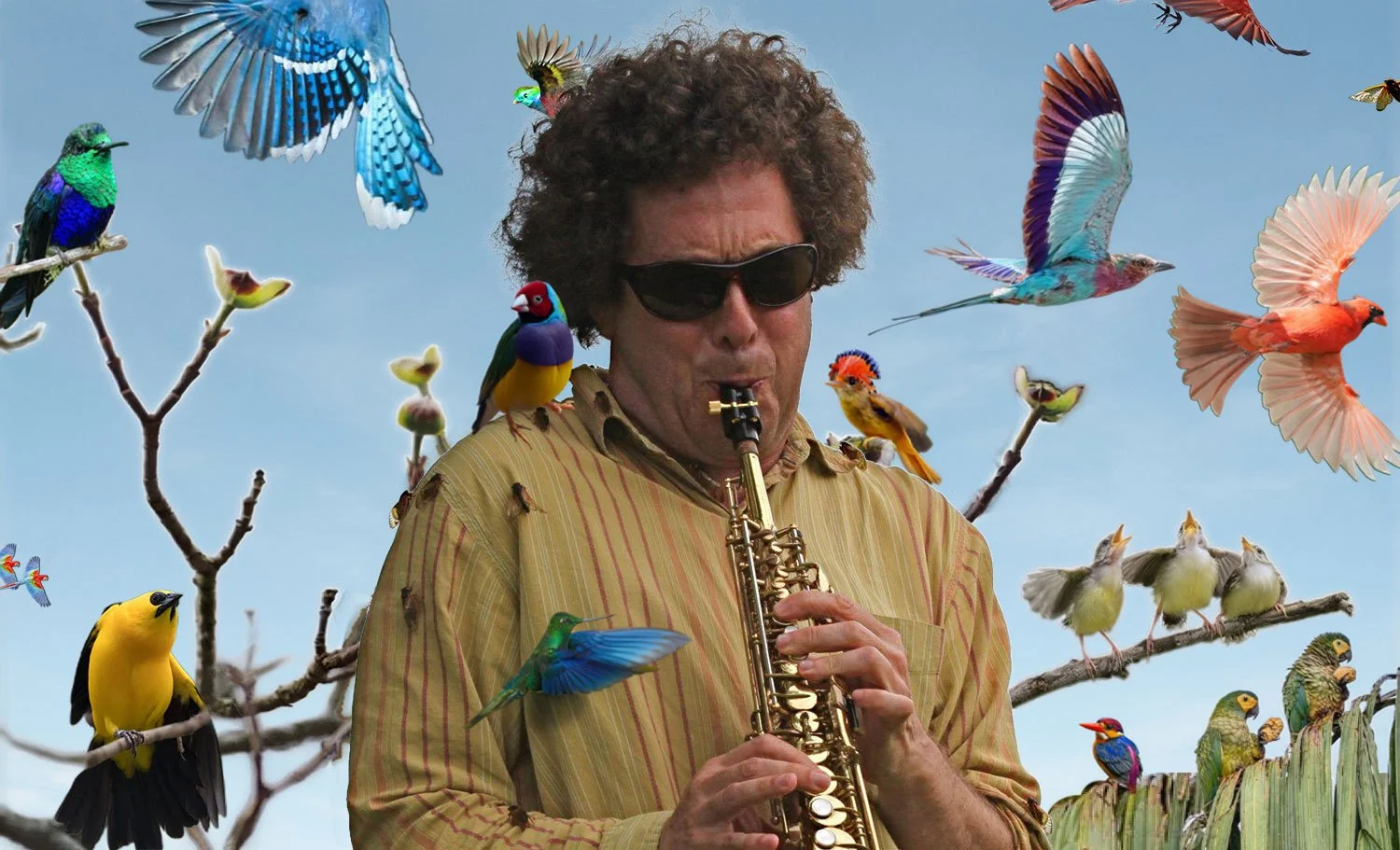
Something to think about: is excited to announce our upcoming event, Lost Steps, a live performance by Hudson Valley-based interspecies musician, philosopher, author, and self-proclaimed “student of the music of other creatures”, David Rothenberg.
Coinciding with the rebirth of Spring and the return to Toronto of our migrating birds, David’s Lost Steps concert is an improvised collaboration, with David playing live along with the creatures he jammed with and recorded in a Colombia rainforest. His musical conversations with birds and other creatures use sound as a bridge. David’s music offers us an engaging way to consider the more-than-human beings in our midst, and to learn how to listen and reflect on what music is, and what it can be.
We invite you to join us in collective, reflective listening!
Lost Steps
Live Toronto Performance
by Interspecies Musician
David Rothenberg
Dates & Times
Saturday, May 2nd, 2026
7:00PM
Sunday, May 3rd, 2026
2:00PM (Children welcome)
Venue:
STTA:’s cultural gathering space at Dundas St West and Dufferin St, Toronto
Note: capacity is limited.
Tickets
“We will not survive as artists or as a species if we cannot become part of the world that surrounds us. There should be no duality between music and nature. Natural sound is never separable from human sound. The moment we decide to listen, to seek out meaning, we start to change the world.”
—David Rothenberg, Sudden Music: Improvisation, Sound, Nature, University of Georgia Press, 2002
Background
David took the name Lost Steps from Cuban novelist, essayist, and musicologist Alejo Carpentier’s most heralded novel, The Lost Steps. The story follows a composer’s journey into the Amazon, where his metaphysical experience yields a “realization that I had just witnessed the Birth of Music”, culminating in the inspiration to write the great symphony of his dreams. After reading Carpentier's book decades ago, David dreamed of hearing this great Amazon symphony himself. At last, in 2024, at the invitation of Diego and Marlene Samper of Calanoa Amazonas and the Wild Symphony Project, David set out to listen to the vast jungle. The result was his eponymously named album, Lost Steps.
David Rothenberg is a distinguished artist and listener, engaging with the natural sounds around us – not as background noise, but as rich, expressive “languages of life” waiting to be explored. Through collaboration with other species, he emphasizes the connection between humanity and the natural world. Rothenberg approaches listening as an act of earthly survival. To engage deeply, expressively, and joyfully with nature is to reconnect with a world from which we, as a species, have become increasingly disconnected. This activation encourages deep listening and environmental awareness, creative expression through music and sound, and a renewed sense of wonder about the natural world.
Rothenberg explores interspecies engagement across many disciplines, including music-making, writing, recording, lecturing, and performance. He lives and works in Cold Spring, New York, and is a Professor of Philosophy at the New Jersey Institute of Technology. David’s many books, including Why Birds Sing, Bug Music, and Survival of the Beautiful, have been published in at least eleven languages. He has released more than forty recordings, including One Dark Night I Left My Silent House, Just Leave It All Behind, and Lost Steps. Nightingales in Berlin and Eastern Anthems are his latest films.
“I say this again and again, and it does seem after a while a refrain, the same simple message, one easy way to make nature matter. Listen to it, and don’t sit passive but love it enough to want to play along. It’s got room for you.”
—David Rothenberg, The Concert of Humans and Nightingales, Why Interspecies Music Works, 2015
Postcards to
Your Future Self
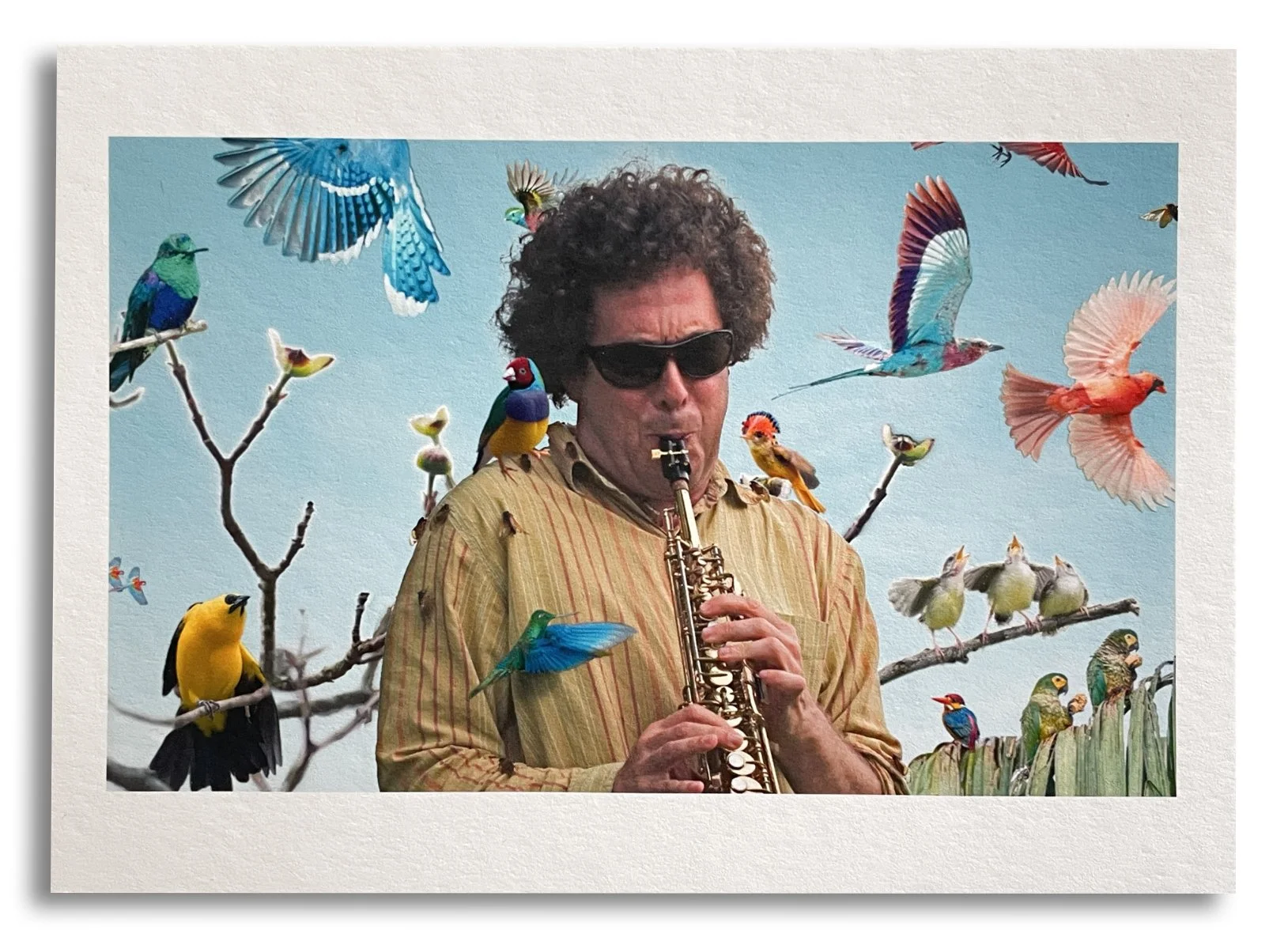
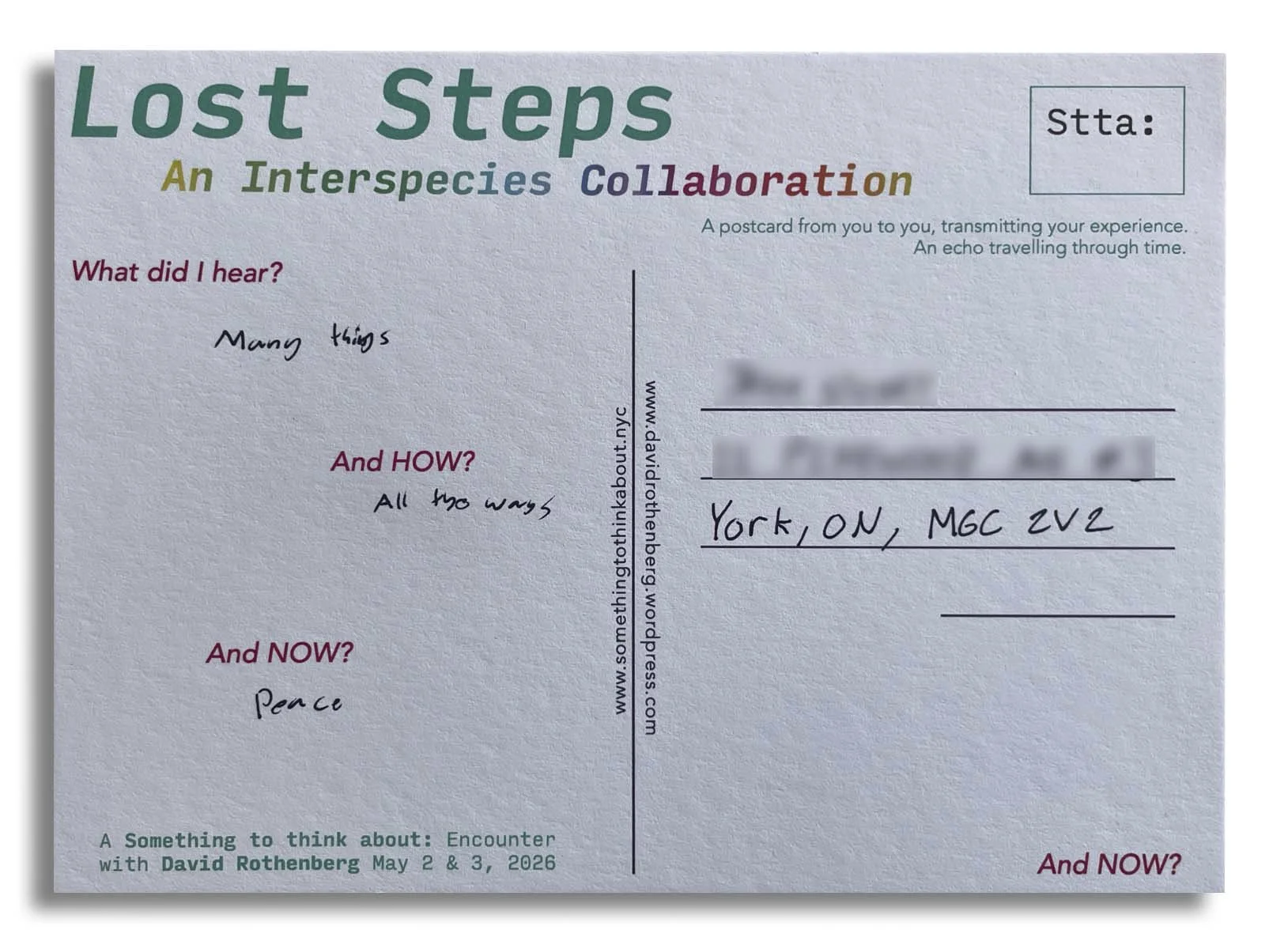
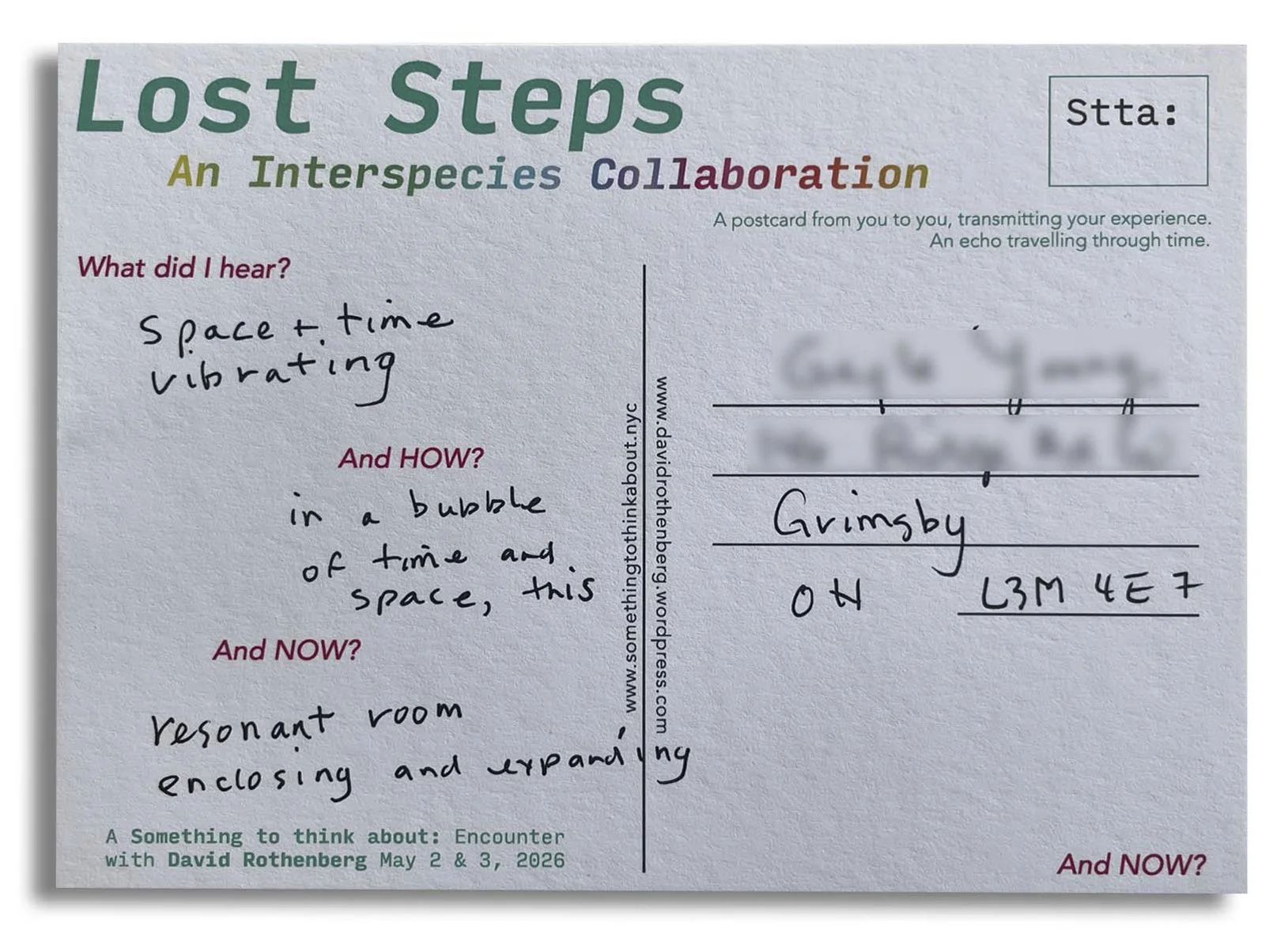
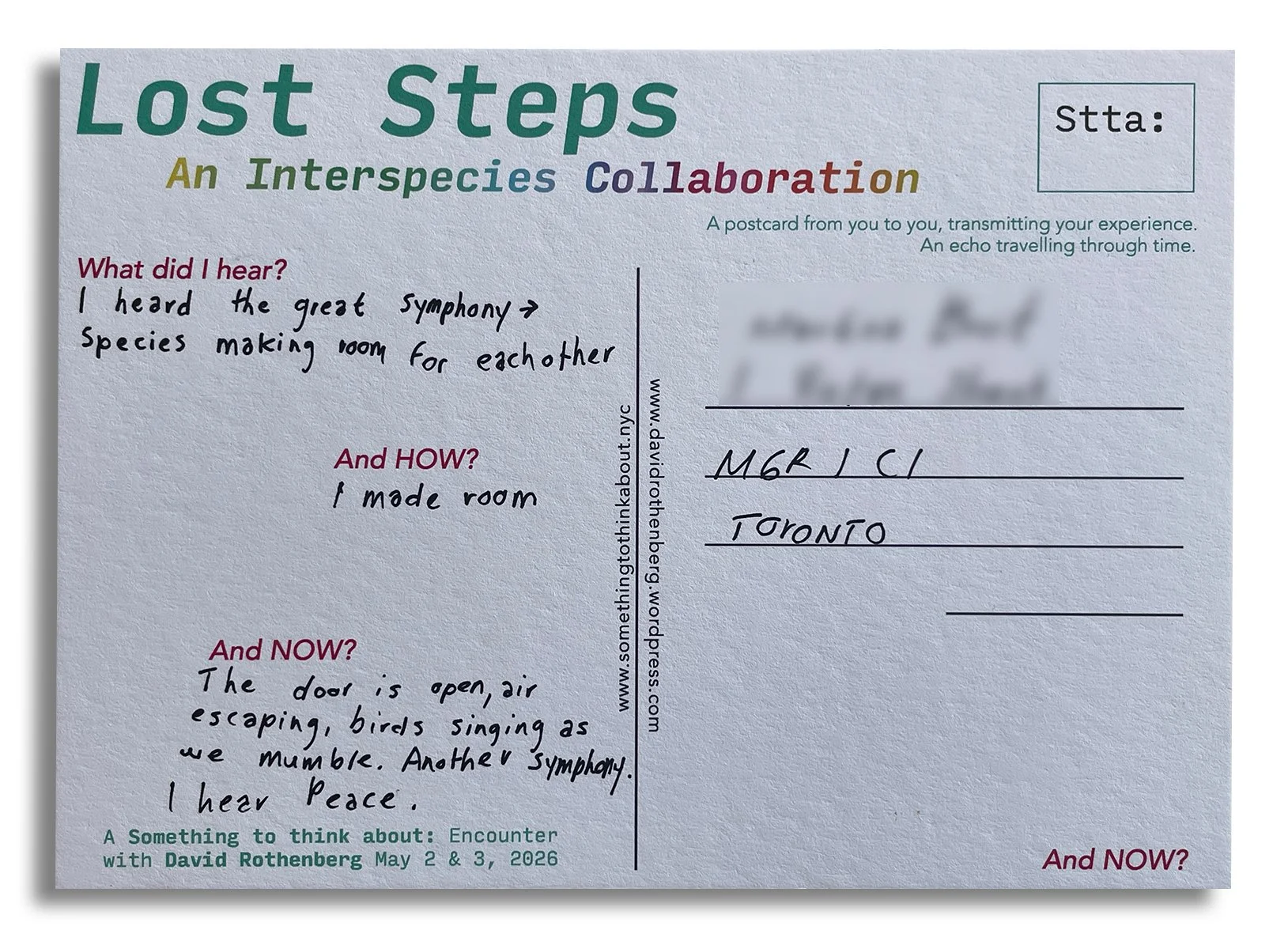
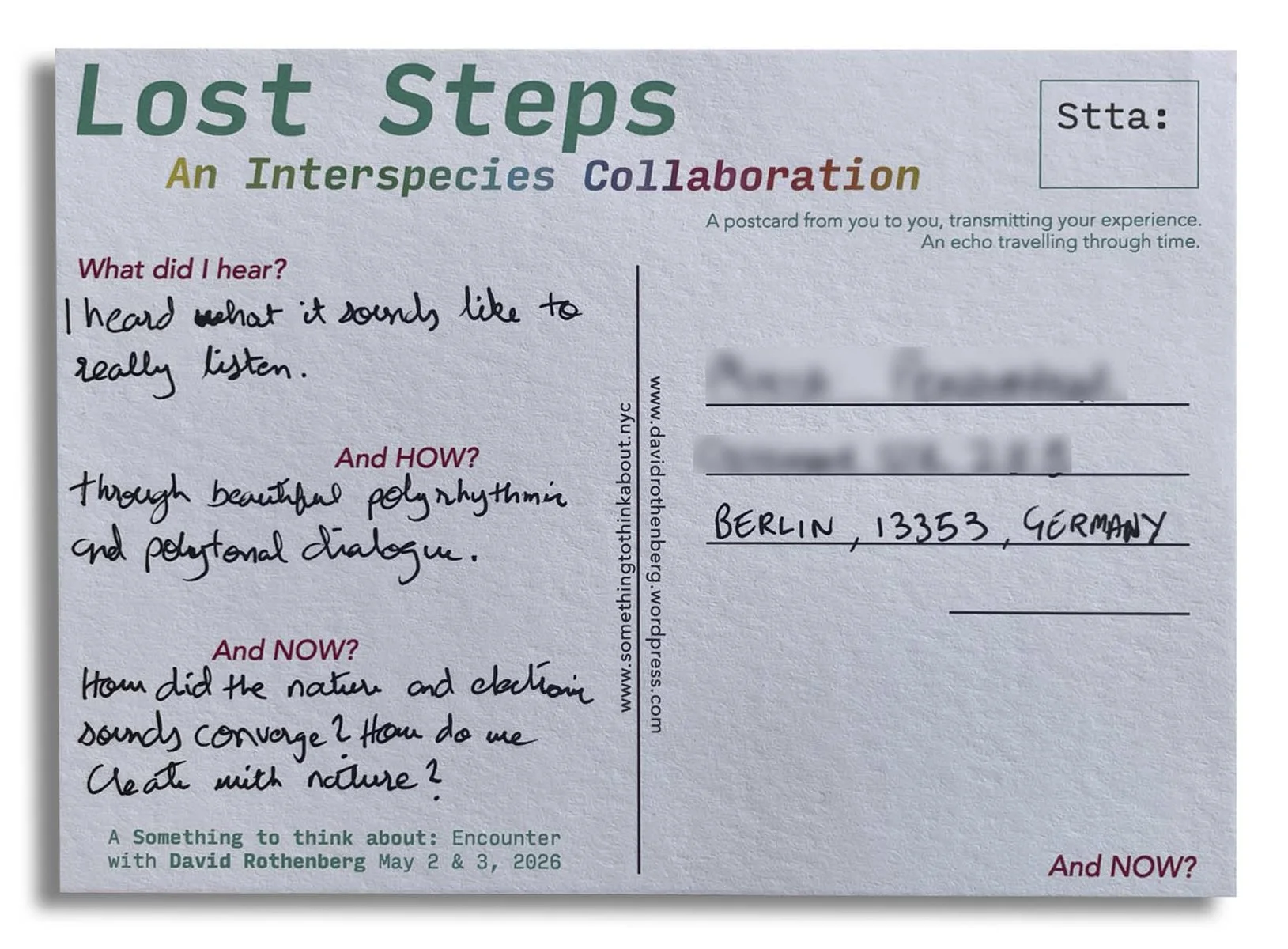
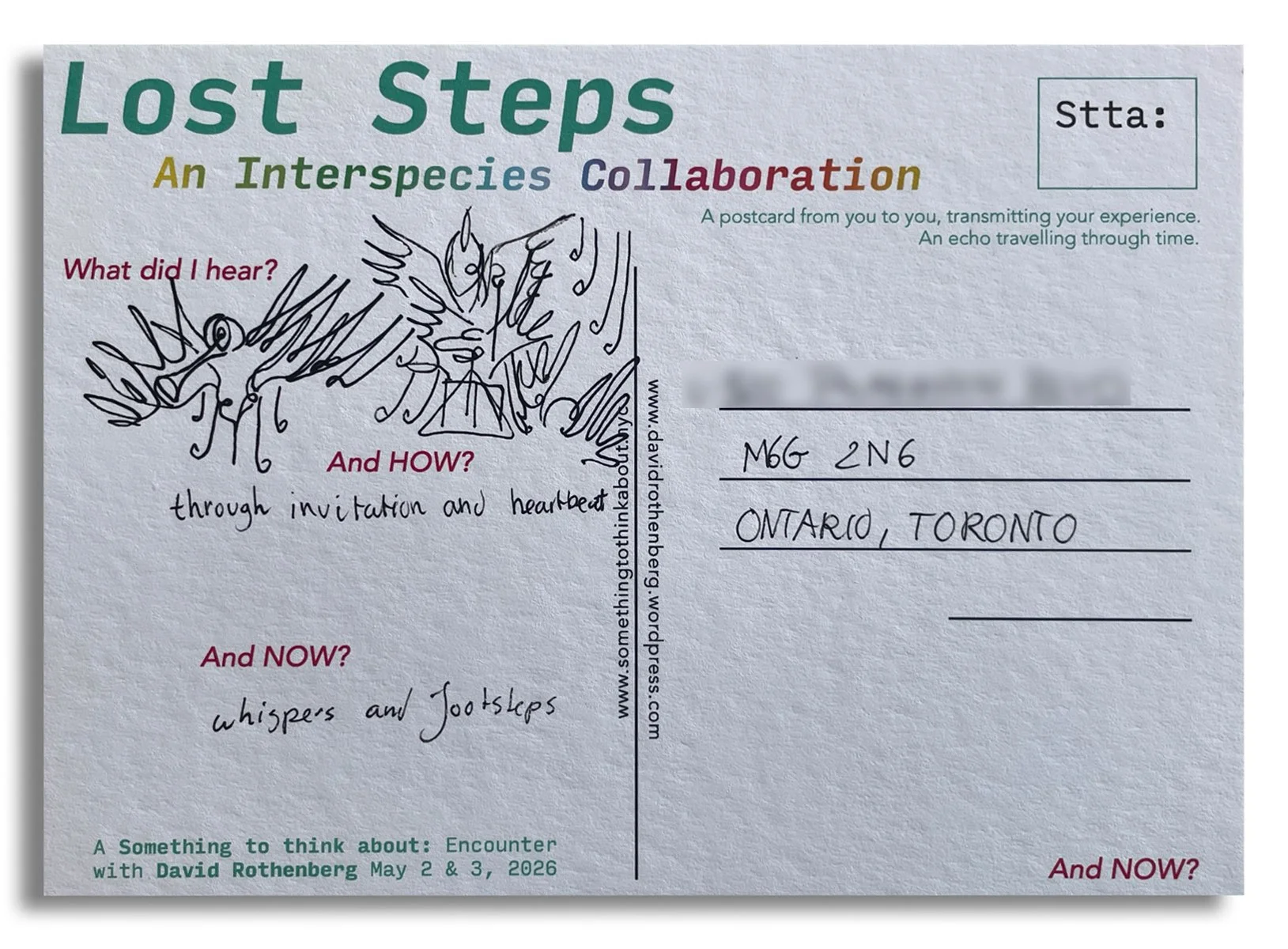
After the performance, and just before a collective conversation with David Rothenberg, participants were invited to write a reflection on a postcard addressed to their future self.
Below is a selection of these postcards before they were mailed out.
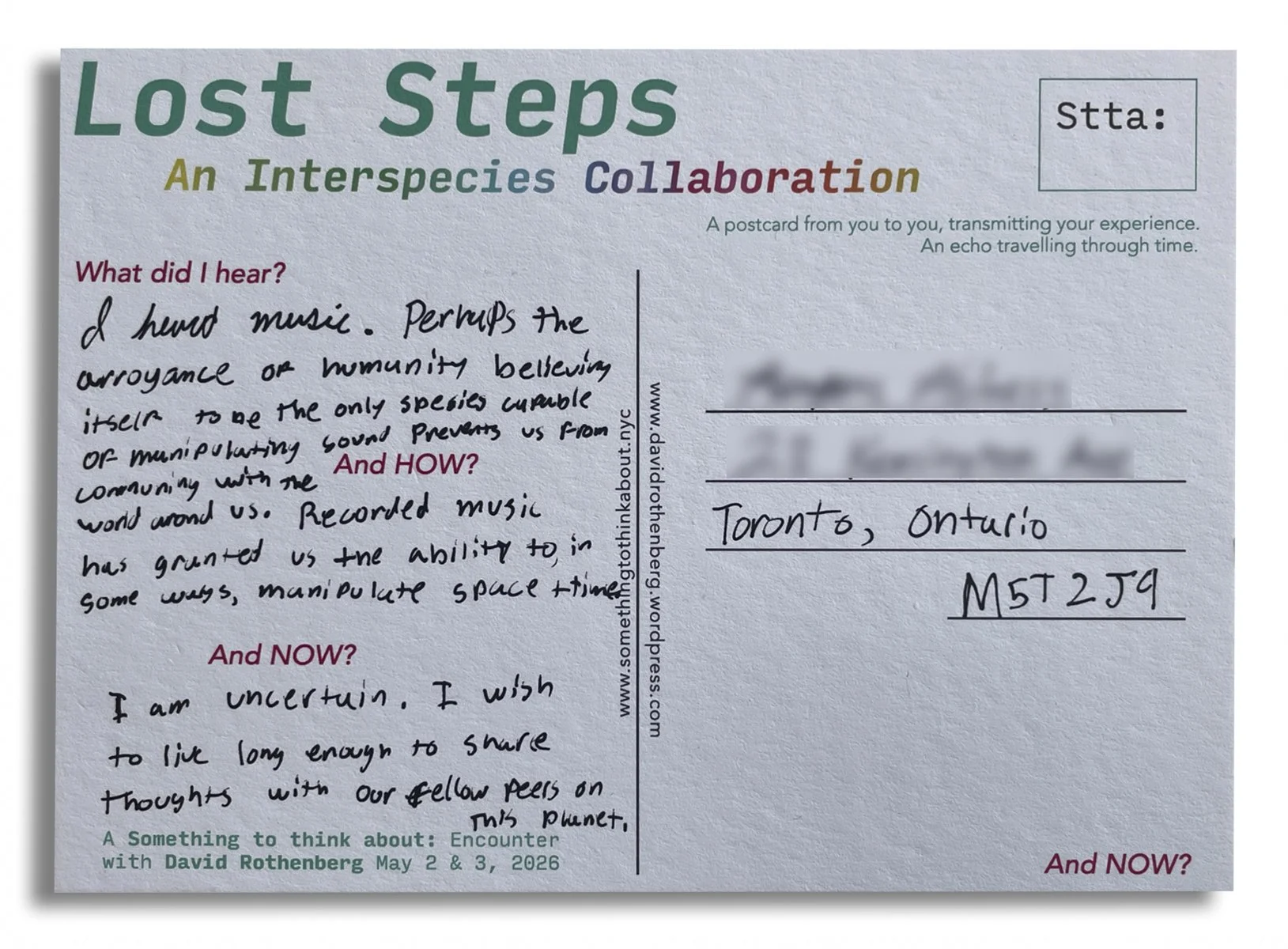
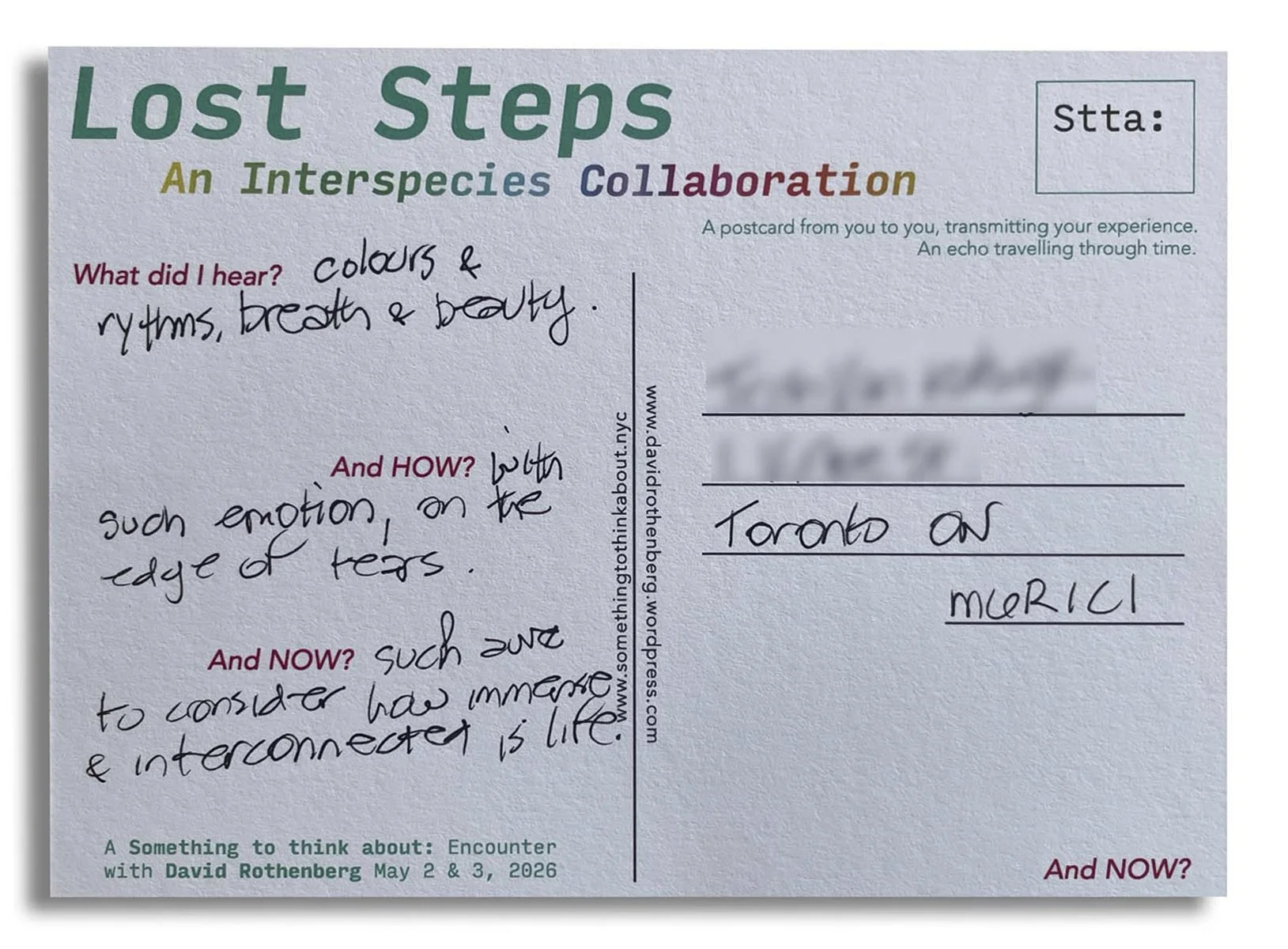
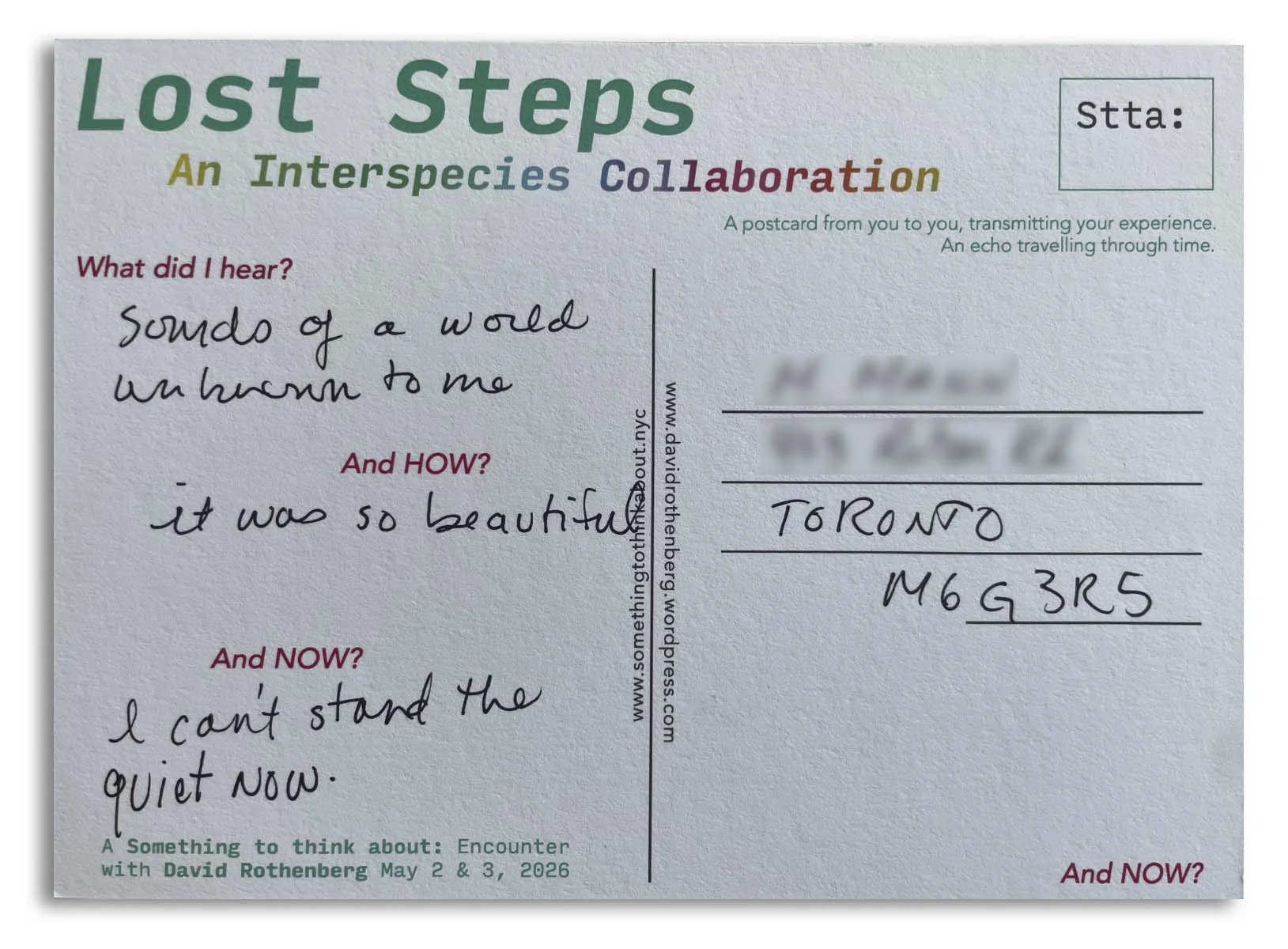
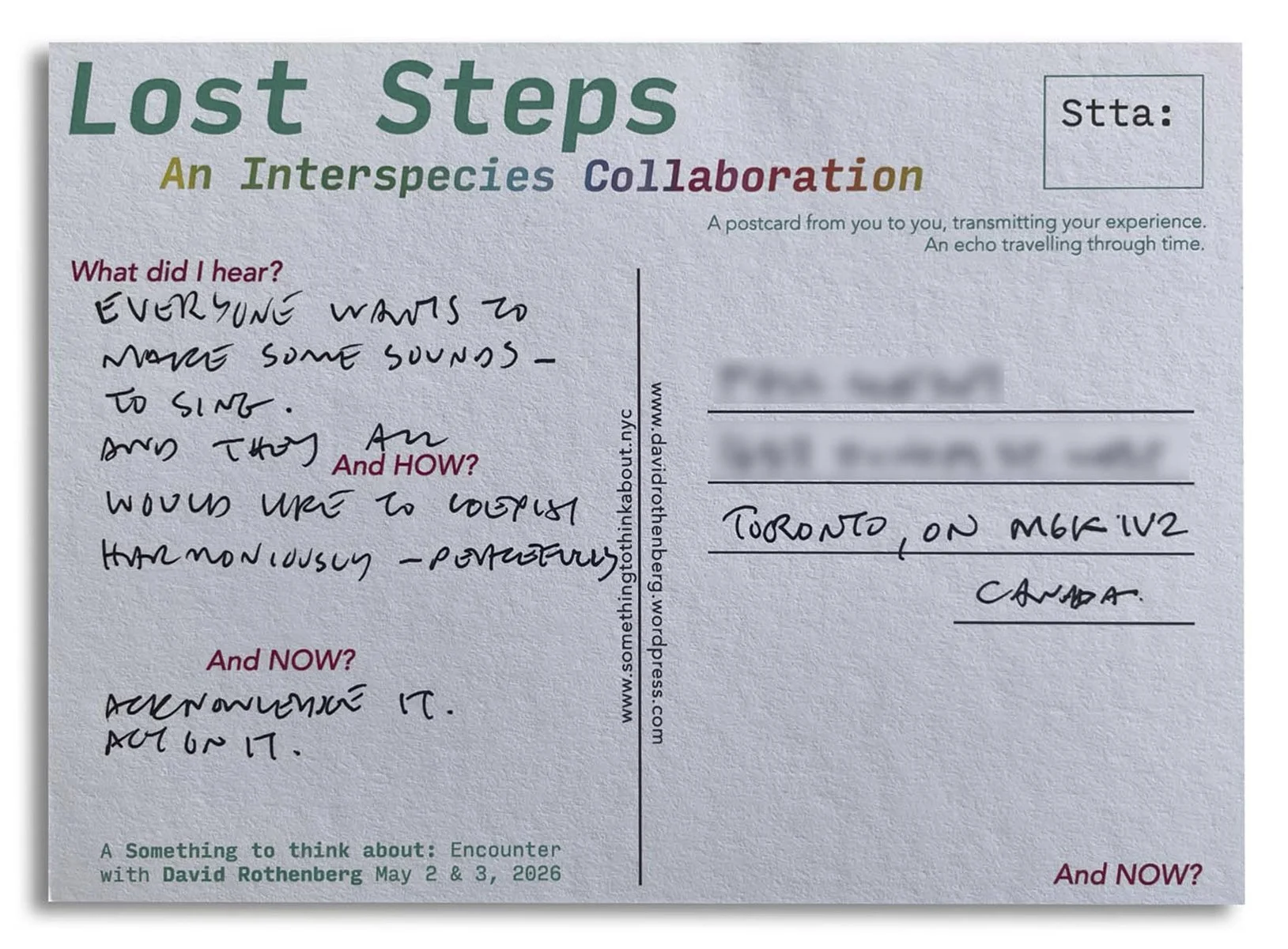
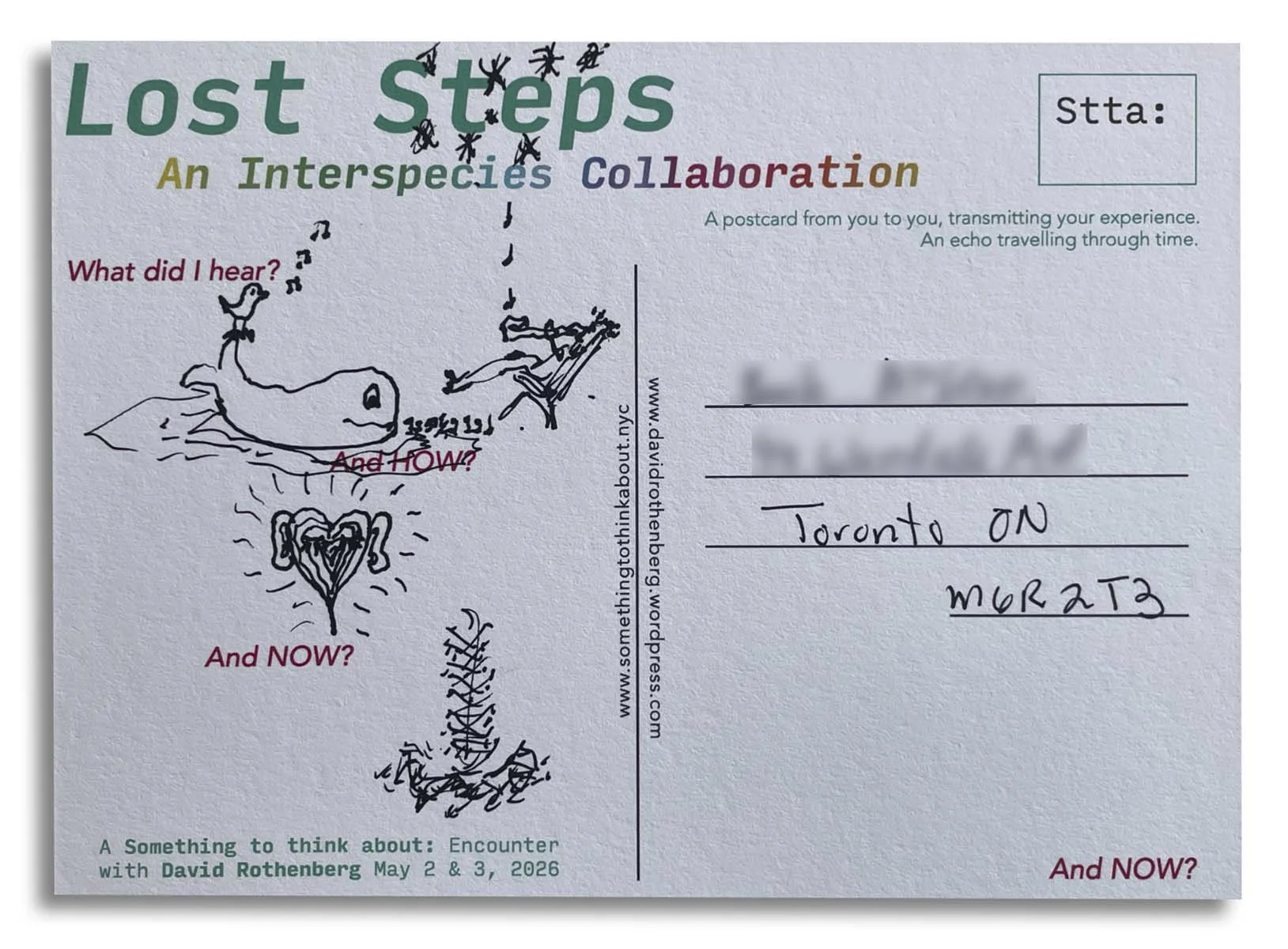
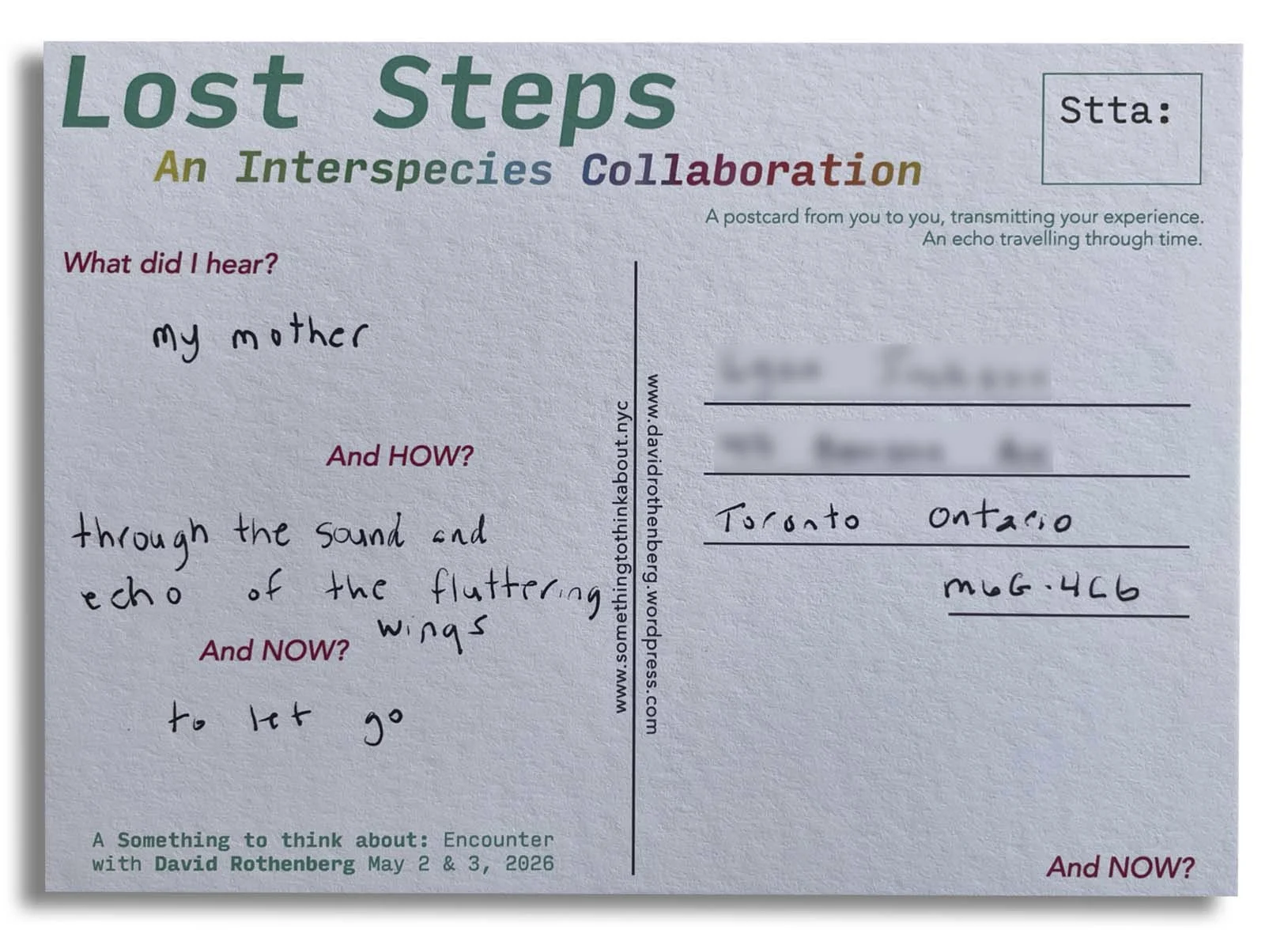
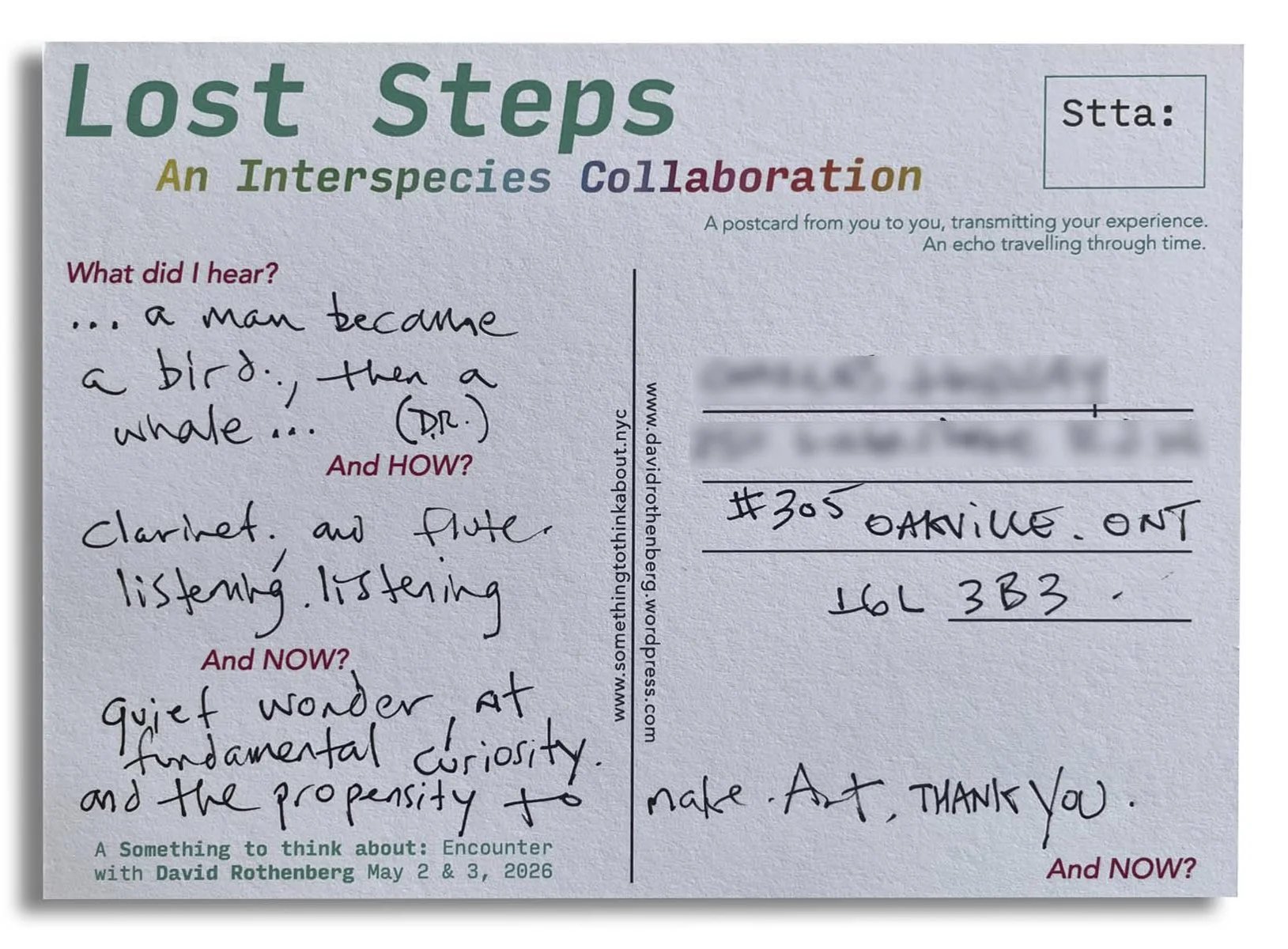
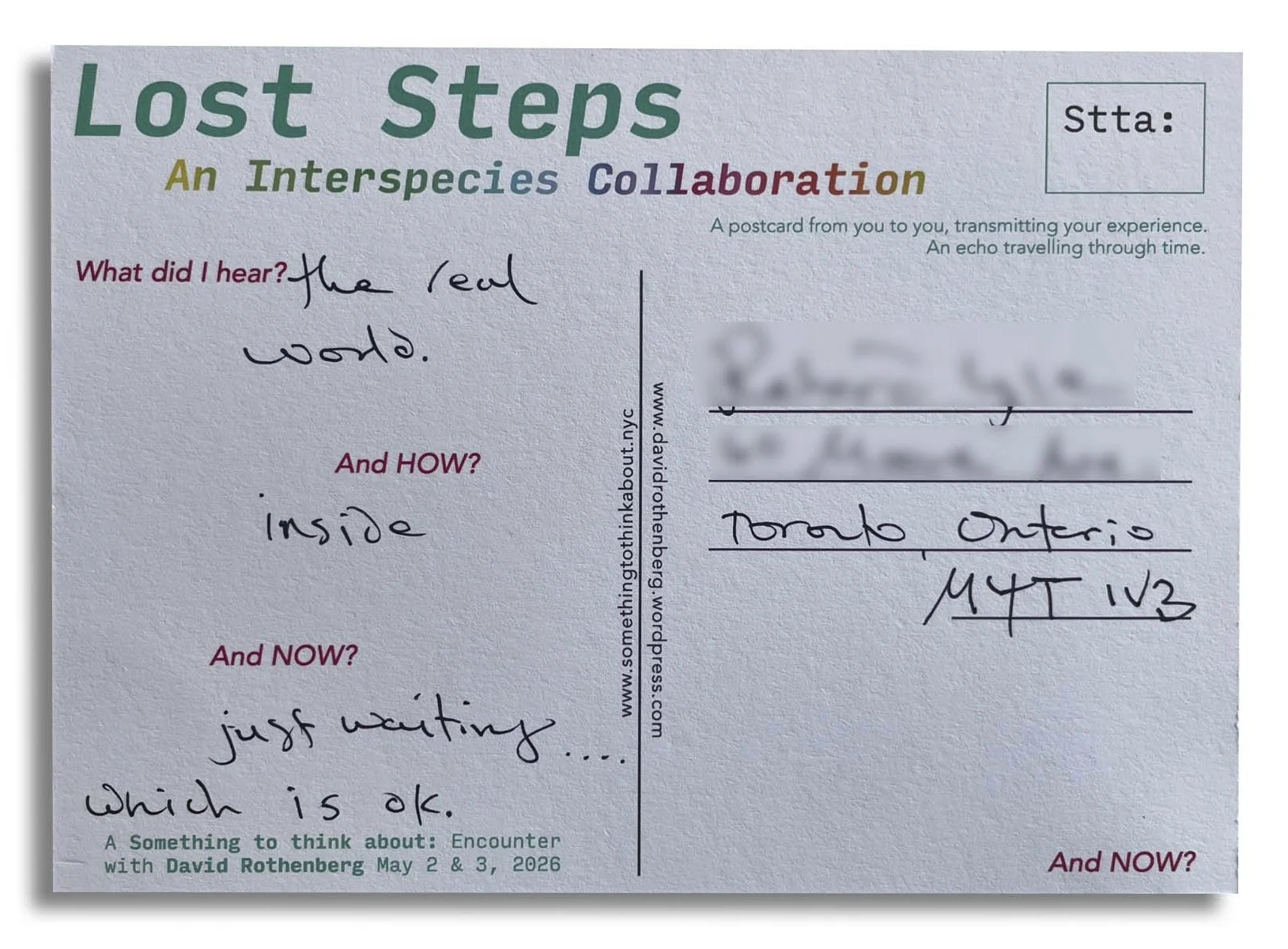
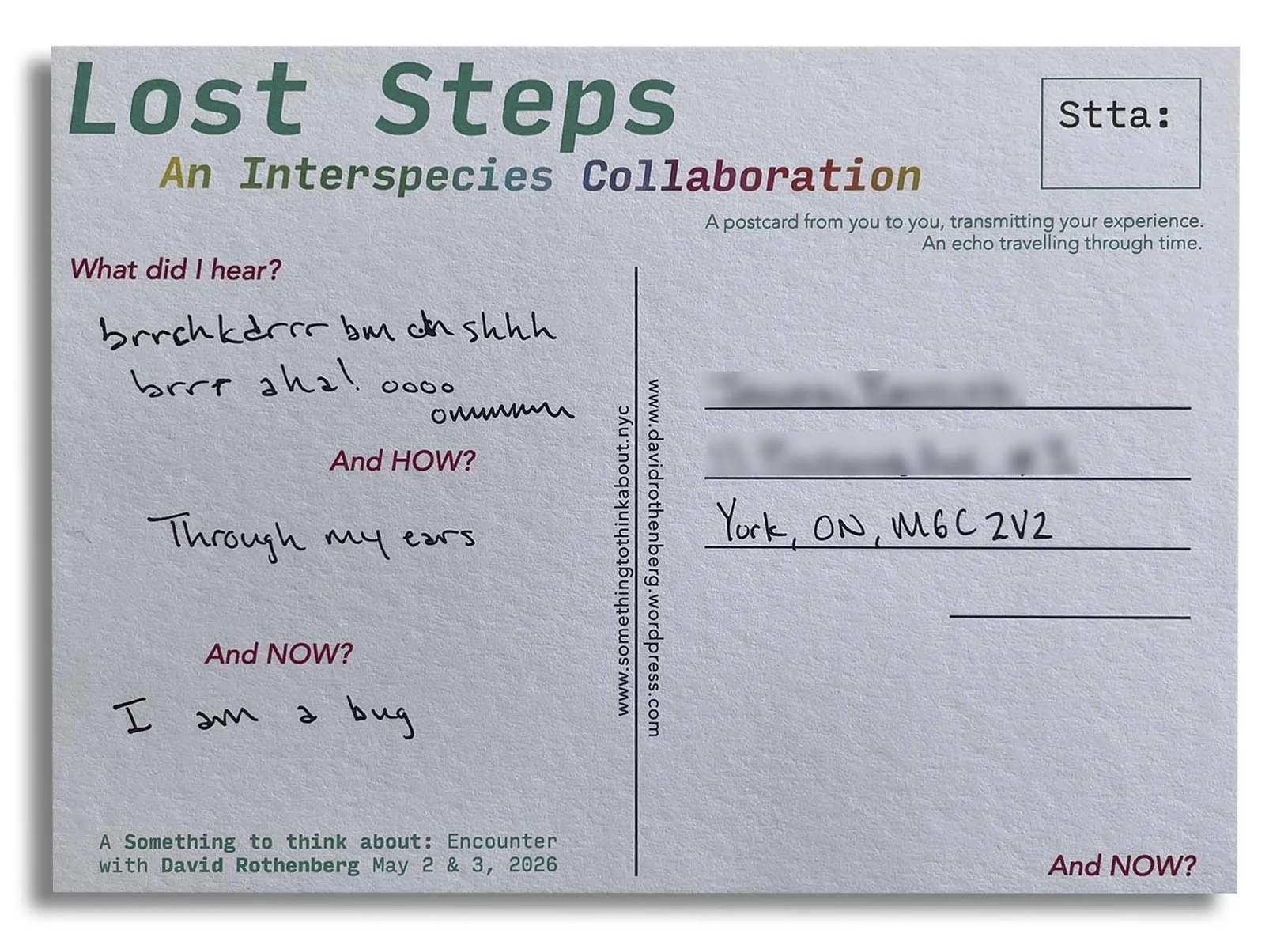
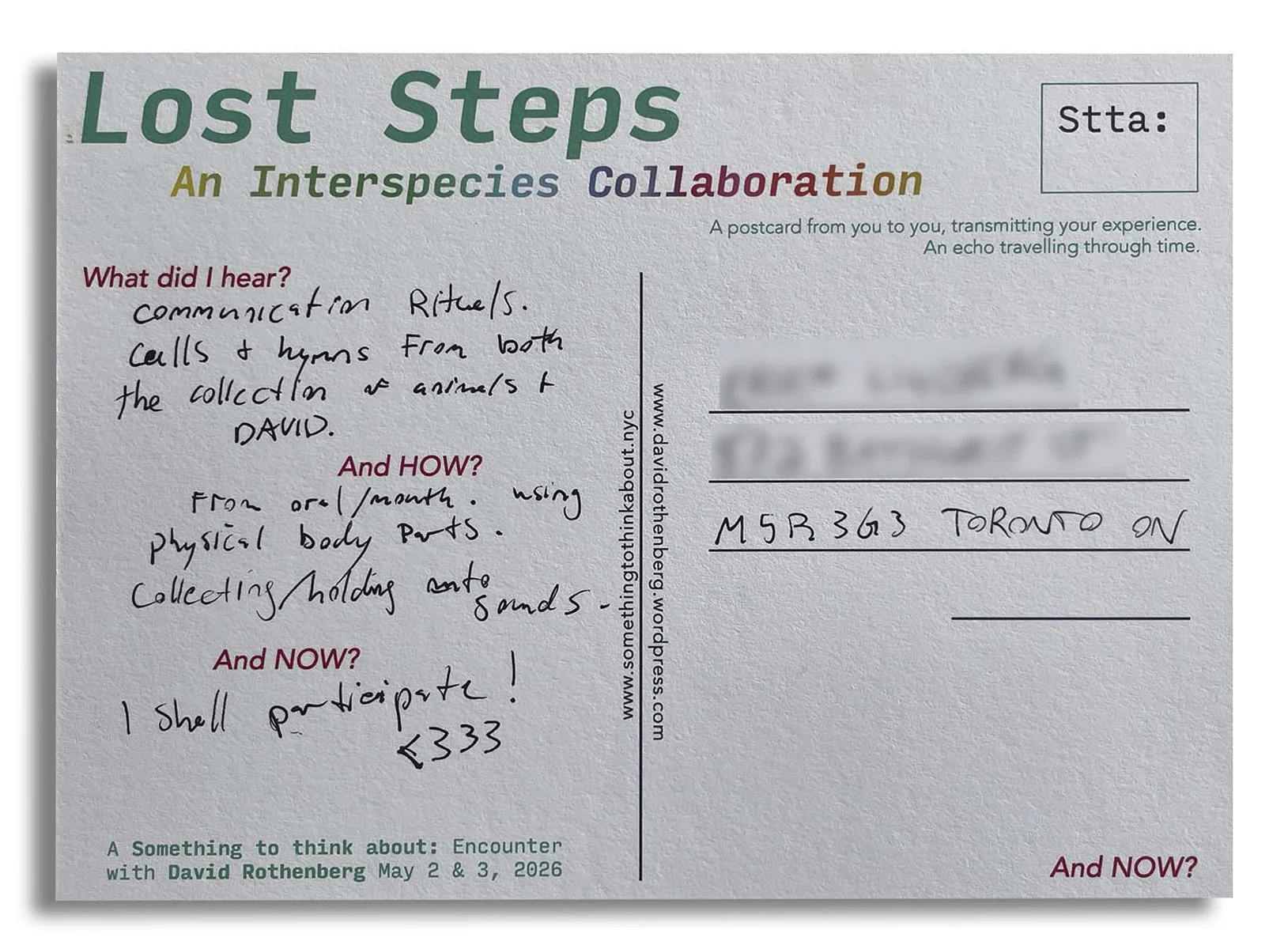
A participant’s reflections
on Lost Steps
On a wind-tossed Sunday in Toronto, I arrived breathless at the STTA: space. Inside, I was immediately met by colour - not static, but alive. Birds of paradise shimmered across the wall in reds and cobalt blues, flashes of gold and iridescent green, their bodies like living brushstrokes. They danced, called, and constructed ephemeral architectures - stages of seduction.
The audience gathered slowly, like a flock finding formation. We settled into a shared stillness, and together we listened. Not passively, but with a kind of awakening attention. The bird calls, at first easily dismissed as instinct - mating, warning, survival - began to unfurl as something more. They seemed to be gestures, phrases, offerings. Already, the boundary between human and more-than-human felt thinner, more permeable.
When the projection faded, the room held a quiet expectancy. We were introduced to Lost Steps, a live, improvised collaboration by David Rothenberg, a listener, storyteller, and self-described “student of the music of other creatures.” His work, rooted in interspecies improvisation, invites us to hear natural sound not as backdrop, but as what he calls the “languages of life.”
Coinciding with the rebirth of spring and the return of migratory birds to the city, David’s performance became a kind of seasonal threshold: a bridge between worlds. Each piece was preceded by a story. These small acts of storytelling drew us closer to lives we rarely notice. Drawing from many recordings of these more-than-human species, he entered into musical conversation with birds, insects, and whales, creatures he had once encountered within the world's breathing orchestra.
The lights had shifted to a deep, warm blue. David began to speak, not as a lecturer, but as a guide. He told stories of nightingales and lyrebirds; and of slowing their songs until hidden architectures revealed themselves as patterns within patterns - a complexity that resisted reduction. These were not merely signals of survival. They were expressions, improvisations, necessities.
They sang. Then, he joined in.
What emerged was not accompaniment, but dialogue. Call and response dissolved into something inseparable. When I closed my eyes, I could no longer distinguish where the bird ended and the human began. There was only relation - a shared act of becoming sound.
In those moments, David’s philosophy became palpable: that there is no true duality between music and nature; that “natural sound is never separable from human sound.” Listening itself felt like an act of transformation. The room shifted so that it was no longer an intimate space in the middle of Toronto, but a submerged expanse. Blue gave way to green. Space gave way to immersion.
As David's instruments changed, so too did the worlds we entered. Cicadas shimmered in dense rhythmic fields. Whales opened vast, slow-moving corridors of sound. The whale song, especially, altered time itself - stretching it, dissolving it. With eyes closed, I felt suspended underwater, yet uncannily awake. The boundaries of my own listening dissolved, replaced by a heightened awareness, as though my ears had learned a new language.
The hour passed like a migration; felt, more than measured. When it ended, we were invited to write postcards to ourselves, to reflect on what had shifted. It was a gesture that extended the experience beyond the room, into memory and future listening.
In the conversation that followed, David spoke of hearing as an act of forgetting names - of releasing the impulse to categorize, and instead allowing sound to meet us as presence. He spoke of listening not as passive reception, but as participation - an invitation to respond, to play along, to become part of the living chorus that surrounds us. And he reminded us that listening deeply is a form of earthly survival.
I left altered, though subtly. The city air felt different, textured by what I had heard. In the mornings since, I wake with the birds, noticing their arrivals, their absences. When their songs are missing, the silence is no longer empty. It is a loss I can feel.
I have not yet joined in. But I no longer believe I would be afraid to.